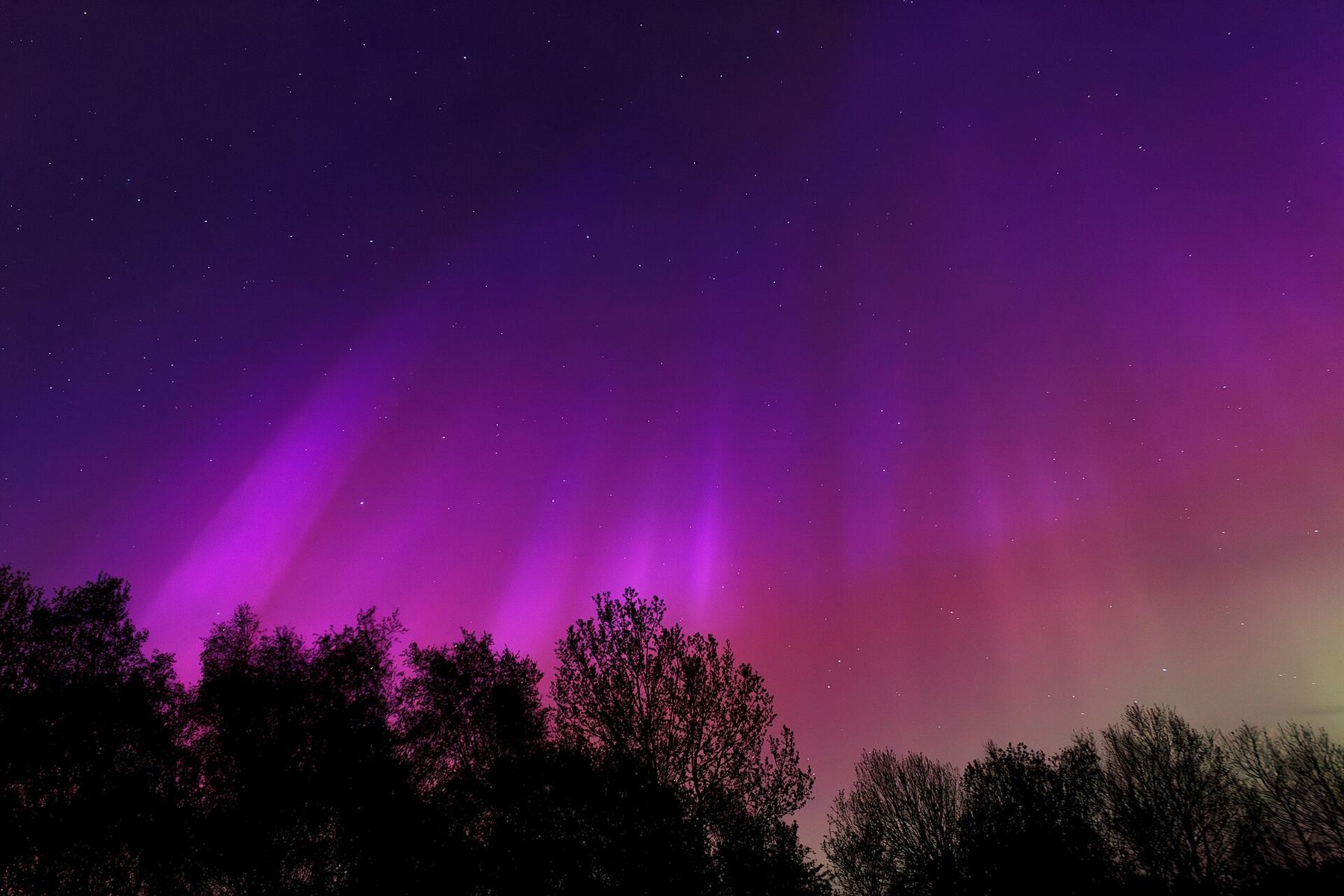
From solar activity to a storm at Earth
On 10 May 2024, Earth encountered a succession of solar eruptions; during the night of 10–11 May, auroras appeared well beyond their usual high-latitude range. NOAA had reported at least seven coronal mass ejections and expected disturbances to continue through the weekend. The sequence matters: the popular phrase “one flare caused the lights” compresses a more complicated chronology. Active region AR3664 was a prominent source of solar activity, while the terrestrial geomagnetic storm is defined by the measured response of Earth’s magnetic environment and atmosphere.
Flares and mass ejections act differently
A solar flare is an enhancement of electromagnetic radiation, whereas a coronal mass ejection carries plasma and magnetic field. The interaction between the arriving field and Earth’s field matters for a strong geomagnetic disturbance. Flare brightness alone therefore cannot automatically predict whether an aurora will be visible over a particular city. NOAA describes geomagnetic storms as consequences of Earth-directed ejections. Forecasting connects observations at the Sun with an expected arrival; the eventual assessment depends on instruments near Earth and measurements on its surface.
How the storm reached G5
NOAA’s operational account described the first arriving ejections and progression through G3 to G4 during the US Eastern-time afternoon of 10 May. The event subsequently reached G5, the highest category on NOAA’s geomagnetic-storm scale. USGS also recorded that classification and provided magnetometer observations. An early publication reporting G4 and a later G5 assessment are not contradictory: they describe different stages. The category expresses disturbance intensity, rather than a mandatory list of failures in every affected country.
Why the sky changed colour
Auroras arise when energetic particles guided by the magnetic field excite constituents of the upper atmosphere. During a strong storm, the region from which auroras can be observed expands towards lower latitudes. NASA Earth Observatory compared photographs from 10–11 May with the unusually broad visibility and described the storm as the most extreme since the 2003 events. Images show the luminous expression, while magnetometers independently measure the disturbance. Agreement between these different observations is more persuasive than assigning a cause solely from an unusual sky colour.
Technical consequences need their own evidence
NOAA warned of risks to navigation, communications, satellites and electricity networks. Those warnings should not be rewritten as proof that every listed malfunction occurred. NIST supplied a well-documented specific example: its F3 and F4 cesium fountain clocks sensed the magnetic-field variation despite their shielding. Scientists applied a correction, and civilian timekeeping continued without interruption. This illustrates both instrumental sensitivity and the value of protective measures: a measurable physical effect does not always become a failure that users notice.
What the different sources establish
NOAA describes ejections and warnings, USGS the ground-level magnetic disturbance, NASA the auroral display, and NIST its own instruments’ response. They document different aspects of one event, rather than offering four interchangeable retellings. USGS’s operational bulletin explicitly said the storm was continuing; its provisional indices should not be presented as the final maximum for the entire period. Our conclusion follows from the matching chronology and measurements: the exceptional auroral visibility is explained by established solar-terrestrial physics, and the striking appearance does not require an unknown source of light.


