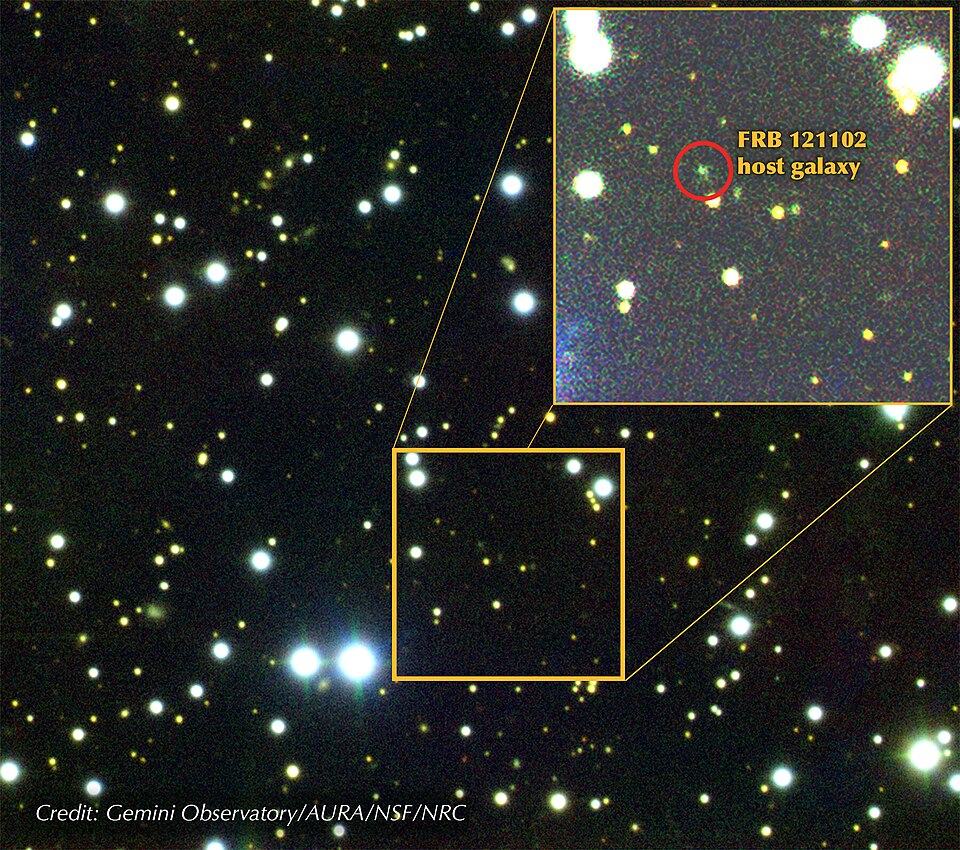
A brief flash and an overly broad direction
FRB 121102 first appeared in Arecibo observations obtained in November 2012. It belonged to the population of short radio flashes for which identifying a place of origin was a major difficulty. A large single dish could detect a pulse while leaving a comparatively broad area of sky. That area might contain several possible counterparts. Choosing an interesting star or galaxy simply because it fell inside the region risked a chance association. Questions about the burst’s nature therefore depended not only on brightness but on an accurate position. Improving that position was essential before an apparent neighbour could be treated as part of the same physical story.
Repetition gave observers another opportunity
Additional bursts were subsequently detected from the same source. This changed the observing strategy: rather than waiting for an unknown one-off event, astronomers could revisit a particular direction using equipment better suited to localization. The team employed the Very Large Array, which combines antennas into a radio interferometer. A 2016 campaign detected nine bursts and substantially improved the position. The result depended on combining a brief event with spatial information, rather than obtaining a long exposure like an ordinary photograph. Repetition did not immediately explain the radiation mechanism, but made a systematic investigation of the source’s surroundings and a search for an optical counterpart practical.
From a radio position to a small galaxy
The refined direction coincided with a faint persistent radio source and a very faint optical object. Further imaging and spectroscopy identified a star-forming dwarf galaxy. Shriharsh P. Tendulkar and colleagues measured a redshift of approximately 0.193. A cosmological model turns that measurement into a distance; public announcements described the source as more than three billion light years away. The observed spectral features and the subsequent distance calculation are distinct parts of the investigation. The central result was a secure association of repeating flashes with an extragalactic object, rather than a direct ruler-like measurement or an assumption that any galaxy in the initial broad region must be responsible.
Longer baselines refined the association
The European VLBI Network and Arecibo helped determine the relative positions of the bursts and persistent radio emission at much smaller angular scales. Benito Marcote and colleagues discussed their close association, supporting a physical connection. This did not turn the region into a detailed photograph of the object generating the bursts. The authors considered different scenarios involving compact astrophysical sources. Persistent radio emission and the brief pulses should likewise not be treated as the same measurement: their shared position was an additional result obtained after repetition was recognised and the broader location had already been narrowed. Successive observations answered increasingly specific questions.
What the three linked studies changed
Localization, host-galaxy spectroscopy and finer radio observations were presented together in January 2017. Each study supplied a different part of the explanation. Researchers first needed repeated bursts, then an accurate position, and then a determination of what occupied that position at optical wavelengths. Together these records strongly supported an extragalactic origin and an association with a particular environment. They did not deliver a final unique radiation model. Our filter uses 2016 for the observing campaign. No terrestrial globe marker is assigned: an antenna’s coordinates are not the galaxy’s coordinates, and a celestial position cannot properly be transferred onto a geographic globe as though it described a place on Earth.


