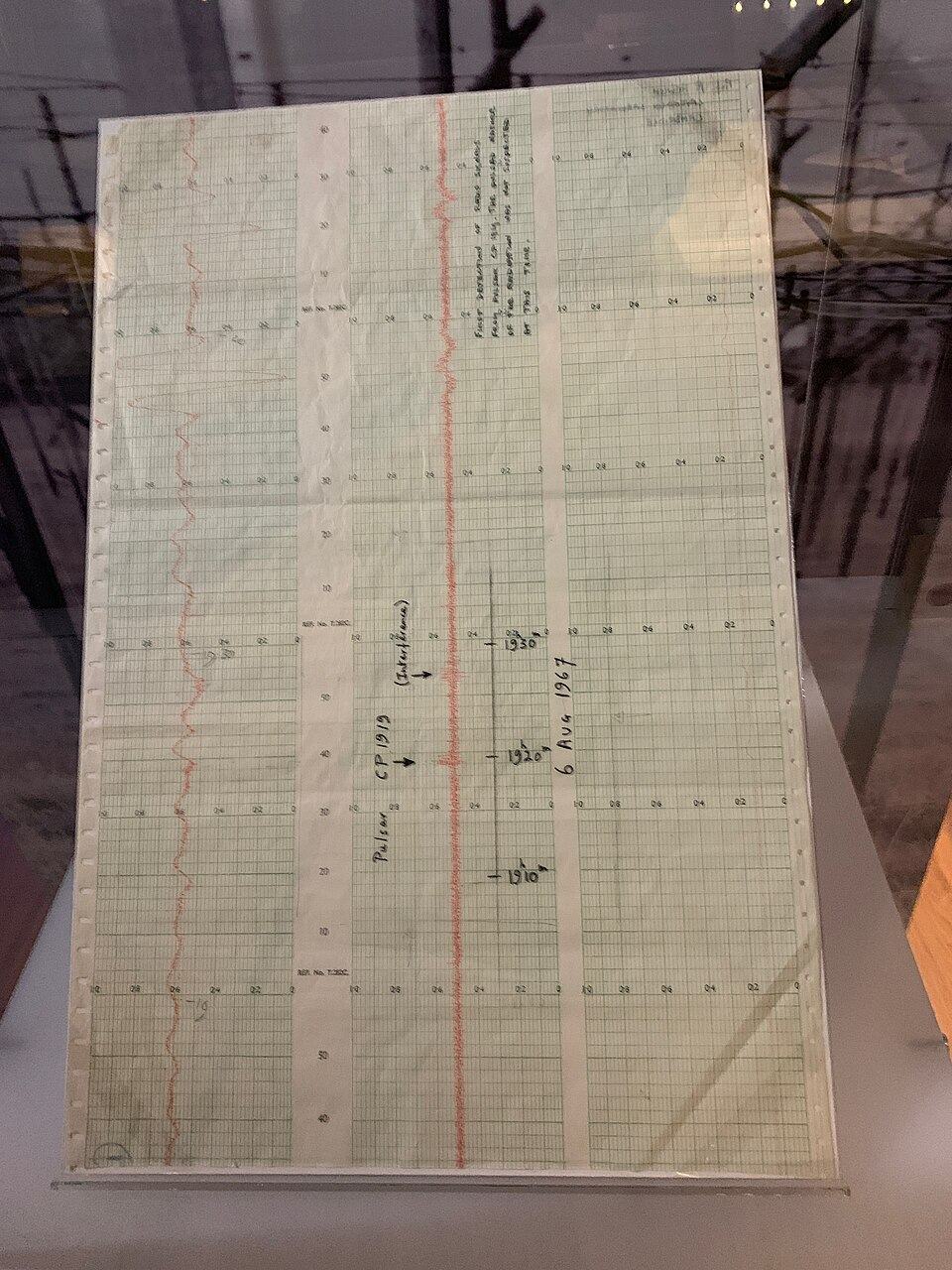
An unexpected mark on paper
In summer 1967 graduate student Jocelyn Bell was examining records from a new Cambridge radio telescope. The antenna system had been built to study the scintillation of radio sources, and results appeared on long paper charts. Bell noticed a small unusual trace among the familiar patterns and kept returning to it. Discovery required attention to something easily dismissed as interference, rather than instant recognition of an established object class. Cambridge's account preserves that sequence: the anomaly first existed as an unusual recurring feature in the data, not as an already identified neutron star.
Faster recording reveals a rhythm
Follow-up observations used a more suitable time resolution during the autumn. By November the signal was recognizable as regular short pulses separated by approximately 1.3 seconds. Bell and her supervisor Antony Hewish checked equipment and possible terrestrial origins. Its recurrence according to sidereal time was important: the direction belonged to the sky rather than merely matching a local transmitter's human timetable. This did not immediately identify the object's physical nature. It did supply a measurable property with which investigators could reject some ordinary explanations and plan more discriminating observations.
The question of an artificial source
The extraordinary regularity produced the partly humorous working label LGM, referring to little green men. Popular histories often make that nickname central, although the investigation consisted of successive tests. Additional similar sources in other directions helped move the interpretation from one strange transmitter toward a natural population. The joke was not an announcement of a received message. No meaningful text or intentional coding had been extracted. The researchers' surprise documents the observation's novelty; it does not establish a technological origin or indicate that a civilization had been positively detected.
The original paper remains cautious
Nature published the paper by Hewish, Bell and colleagues on February 24, 1968. Its summary discussed objects within the Galaxy and possible associations with white dwarfs or neutron stars. The first paper should therefore not be credited with a fully completed modern model. Discovering the recurring source and explaining its engine were separate stages. Later physics connected pulsars with rapidly rotating, strongly magnetized neutron stars whose emission beams periodically sweep past Earth. The observed rhythm became a tool for studying extreme matter rather than a reason to preserve the initial transmitter speculation.
Who noticed and who recounted it
NASA and Cambridge explicitly credit Bell with discovering the unusual sequence in the records. Hewish's Nobel lecture supplies the project leader's perspective and acknowledges her persistent examination of survey charts. These sources differ in authorship and timing, making joint reading useful. Later fame should not erase the observer's contribution behind a laboratory's collective name. Geographic coordinates are deliberately absent from this entry: the antennas' terrestrial location is not the pulsar's location, and celestial right ascension and declination cannot be substituted for latitude and longitude on an Earth map.
Comparing stages of discovery
The university history follows a paper trace into observational tests, the original publication records early 1968's cautious conclusions, and physical overviews describe the accepted interpretation of pulsars. Dates need separation: observational discovery belongs to 1967, while the journal paper belongs to the following year. Unlike a single uncertain report, this history contains repetitions, a measured period and additional sources for comparison. Its scientific strength lies in that checkable sequence. An unexpected anomaly became a natural object class through work on evidence, rather than through the memorable nickname that later became attached to the story.


