A discovery that looks like a ready-made story
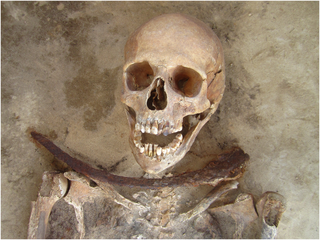
At Drawsko in Poland, archaeologists investigated an early modern cemetery containing graves with unusually placed iron sickles and stones. In photographs the objects can resemble devices for restraining the dead, and the scholarly literature discusses anti-vampiristic practices. The evidence is nevertheless first of all material evidence of a mortuary rite. It preserves actions performed by living people. It does not demonstrate that a person buried there could return after death or possess a supernatural biological identity.
What was actually in the graves
The 2014 study discussed six unusual interments among 285 recovered skeletons. Five involved sickles, while stones could be positioned near the lower jaw; people of different ages and sexes were represented. A separate paper by Marek Polcyn and Elżbieta Gajda examined five sickle burials in detail. These are not independent discoveries of six and five vampires. Different researchers were defining different subsets within the same archaeological cemetery, a distinction easily lost when headlines replace the underlying studies.
Were these people outsiders
One testable hypothesis connected unusual funerary treatment with the perceived foreign origin of the deceased. Strontium isotope analysis of tooth enamel did not support that straightforward explanation. A later oxygen and carbon isotope study likewise found no significant difference between groups and supported predominantly local origins. The authors also acknowledged limitations: similar environmental isotope signatures over large regions may conceal some migration. An isotope result is not an individual passport, and local origin alone cannot explain why an unusual rite was selected.
Protection from the dead or protection for them
A sickle may have been regarded as an object with protective power. Researchers discuss multiple possible meanings, including social identity, circumstances of death, demonic beliefs and a protective function. Calling a burial a vampire grave therefore removes an important part of the problem. Distinguishing interpretations requires the objects’ positions, the wider cemetery context and comparable written or ethnographic material. The presence of a blade by itself does not tell us exactly who was supposed to be protected, or from what threat.
What the chemistry cannot establish
These studies do not offer a laboratory test for vampirism. Nor do they establish one definitive reason why each individual received unusual mortuary treatment. A lack of obvious skeletal differences cannot exclude every illness or every form of social distinction. Conversely, an unusual rite cannot retrospectively prove that a dead person committed crimes or posed a danger. The remaining uncertainty concerns human motives and cultural meanings. It is not indirect confirmation of an undead creature hidden behind an unresolved archaeological explanation.
Dates and the atlas marker
The burials belong to the seventeenth and eighteenth centuries, but exact years for individual deaths are not established. We therefore do not assign the record to every year in that range or present the 2014 publication year as a vampire sighting. The marker locates the Drawsko area rather than a specific grave, and the forest cover is illustrative. The story matters because real archaeological evidence can test some popular explanations while demonstrating how far an arresting headline can drift from the results of the underlying investigation.


