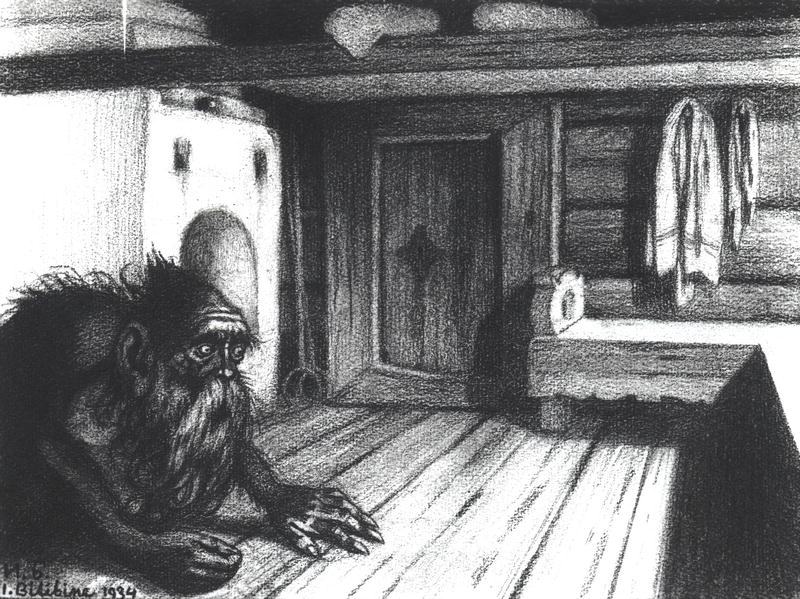
Who lives behind the stove?
Rustling behind a stove at night, a horse with a tangled mane in the morning, and a run of bad luck after moving home could all find a common explanation in a traditional story: the domovoi. The character was imagined as master of the household, a family protector and a being capable of anger. There was no single compulsory portrait. Names, appearances and actions varied between places. These accounts are therefore more revealing as a family of local narratives than as reports of encounters with an animal consistently described by different observers.
Moving house with its invisible master
One particularly memorable motif is inviting the old household master into a new dwelling. Descriptions of the belief connect that move with domestic objects; ashes or embers from the former stove also appear. The story can be read as making the new home a continuation of an inhabited world without accepting a spirit literally. That is our interpretation of a cultural function, however, rather than an explanation necessarily offered by every participant. A local custom should not become a rule supposedly followed by all Slavic communities, or a practical procedure guaranteed to work everywhere.
Braided manes and remembered encounters
Field materials published by the R. G. Kuzeev Institute for Ethnological Studies preserve accounts of tangled hair and horses’ manes attributed to a domestic spirit, also addressed as a little neighbour. Local vocabulary, context and the narrator’s explanation are central to such records. The speaker may be retelling a relative’s experience rather than claiming a personal sighting. An informant’s birth year, the interview date and the supposed time of the episode are three different things. None automatically becomes a year in which the domovoi was observed in our atlas.
What ethnographers investigate
A study of Russian communities in Dagestan, published in History, Archaeology and Ethnography of the Caucasus, examines the belief through fieldwork and written sources, including the character’s imagined locations, communication, helpful behaviour and harmful actions. This investigates the circulation and transformation of an image. It does not report an experimental detection of an invisible creature. Chulkov’s historical volume in the Presidential Library also needs to be read according to its genre: a collection of beliefs. The catalogue describes a Moscow edition from 1861 drawing on a dictionary published in 1782. Those are bibliographical dates, not dates of an encounter with a spirit.
Separating a story from its proposed cause
Repeated knocking, a misplaced object and a nighttime sense of presence are different experiences requiring different investigations. A useful first step is to describe an episode without naming its assumed agent: where the sound occurred, who was nearby and whether an uninterrupted recording exists. The household’s explanation can then be recorded separately. This preserves the human story while allowing competing interpretations to be compared. A familiar name is not itself an established cause. There is no defensible single point on the globe for an entire folklore character, so this article remains in the thematic archive without a marker. Missing coordinates mean there is no unique event location, not that the material has vanished.


