A daylight trail over North America
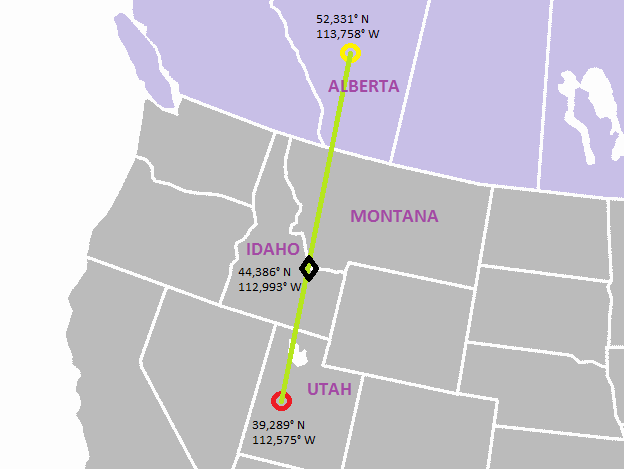
On 10 August 1972 an exceptionally bright fireball crossed western North America. It was visible in daylight, when faint meteors disappear against the bright sky. Reports associate the passage with a broad region from Utah to Alberta. Unlike the familiar story of a space rock that must fall somewhere ahead, this object grazed the Earth and continued into interplanetary space. The combination of brilliance, an extended path and atmospheric escape made the event famous. The later name Great Daylight Fireball refers to that observation, rather than to a separate recurrence of the phenomenon.
Mountains and a lake in the photograph
One celebrated photograph shows the luminous trail over the Teton Mountains behind Jackson Lake in Wyoming. NASA presented it with an explanation in Astronomy Picture of the Day. Daylight and fixed landscape features make the spectacle easy to appreciate. A single viewpoint, however, does not supply the true altitude or path length. A distant bright object can appear close, while an angle in an image is not automatically a distance in kilometres. Turning an impressive photograph into a reconstructed trajectory required additional observations with a different viewing geometry. The landscape provided context, rather than a complete measurement by itself.
A satellite adds an independent observation
In a 1974 paper Rawcliffe and colleagues reported that a satellite-borne near-infrared radiometer had also detected and tracked the meteor. A ground-based observation by surveyor W. T. Rogers of Billings, Montana, added altitude information. The authors combined these measurements to calculate the trajectory. The investigation therefore did not consist of choosing whichever impression was most common among witnesses. Independent recording methods constrained where the body could have been. Publication followed the event: 1974 identifies the scientific paper, while the atmospheric encounter occurred in August 1972. Keeping those dates distinct prevents a later analysis from becoming a second supposed sighting.
What skipping off the atmosphere means
NASA's popular explanation compares the event with a stone skipping across water. The image helps distinguish a grazing encounter from deep entry, but the atmosphere is not a solid surface. A body interacts with thin gas, heats and loses energy while Earth's gravity also shapes its motion. With appropriate geometry, the surviving path takes it back out of denser layers. This appearance does not require a controlled manoeuvre. Nor does one successful atmospheric exit establish that every equally bright incoming object will pass safely by. Speed, angle and physical properties matter, and cannot be assigned identically to every fireball.
A predicted return and the limits of knowledge
In a 1994 conference contribution Martin Connors discussed a possible renewed approach to Earth in 1997. This was a calculation and a proposal for directed searching, rather than a report of rediscovery. He noted the object's small size and expected faintness. Comparing the paper, satellite observations and NASA account supports a natural explanation of the encounter. A predicted orbit has its own uncertainties and does not turn a forecast into an observation. The archive includes the event because an extraordinary sky display could be connected with measurements while preserving the distinction between what was seen in 1972, its later reconstruction and a hypothetical future return.


