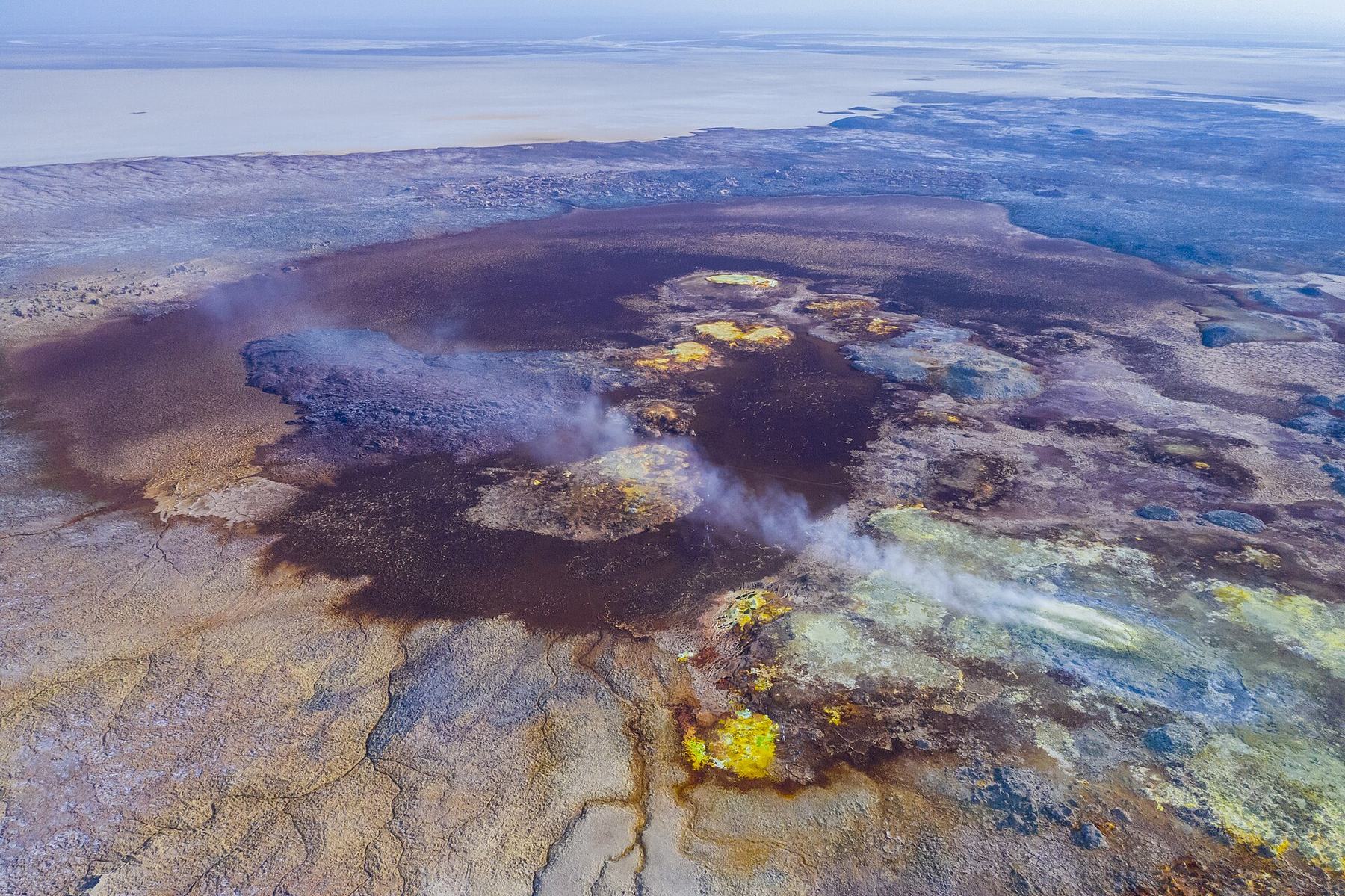
Yellow terraces among salt
At the Dallol hydrothermal field in the Danakil Depression, hot brines emerge among thick salt deposits. Yellow and orange crusts, greenish pools and small mineral structures produce a landscape readily mistaken for an image of another planet. The setting is nevertheless a terrestrial system combining underground heat, water, salts and chemical transformation. Color alone does not establish the presence of an unusual organism.
Field teams examine several different environments: springs on the dome, neighboring saline lakes, wet crusts and cave water. Sampling sites can lie close together while differing substantially in acidity and brine composition. The phrase Dallol water therefore conceals many environments that cannot be combined into one sample or one biological answer.
Searching for microscopic inhabitants
In 2019 Felipe Gomez and colleagues reported indications of extremely small microorganisms in material from Dallol's extreme conditions. For researchers studying life's origins, such a discovery could extend the range of plausible habitats in hot, acidic and salty water. Small rounded structures in mineral deposits, however, are difficult to distinguish from forms produced without living cells.
That same year a team including Jodie Belilla and Purificacion Lopez-Garcia published a study drawing different boundaries. The researchers combined genetic methods, microscopy, chemical measurements and contamination controls. They detected highly diverse archaea in nearby hypersaline environments with milder acidity. They found no convincing evidence of an active local biosphere in the most acidic, salt-saturated pools.
Why a shape is not yet a cell
The investigators compared genuine cells with mineral biomorphs capable of producing similar spheres, threads and envelopes. Wind and visitors can also introduce biological material into places where it cannot reproduce. A detected DNA sequence consequently requires further questions: does it represent a resident community, transported material or laboratory contamination? Negative controls matter as much as visually impressive micrographs.
A later study of the complex's waterbodies, published in 2023, continued comparison of chemistry, minerals and biological signals. It also challenged a straightforward interpretation of very small objects as inhabitants of the most extreme waters. These investigations describe a region with sharp habitability boundaries, rather than a place that somehow overturns biology as a whole.
Comparison with other worlds
Dallol is valuable as a terrestrial analogue for searching beyond Earth: liquid water alone does not guarantee that temperature, acidity and salts jointly permit cells to function. The analogy does not make its pools exact replicas of Mars. Here the geology can be studied directly, samples can be collected repeatedly and terrestrial contamination sources can be investigated. The explained status concerns the natural landscape and its chemistry; disputes about particular biological signatures retain their own limits. No single year is assigned to the continuing process, and absence of detected life in particular brines is not generalized to the entire varied region.


