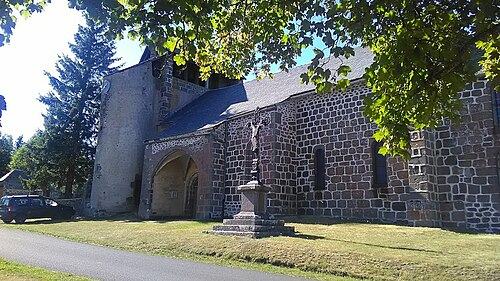
A morning beside the cattle
On August 29, 1967 a brother and sister were tending their family's cattle near Cussac in France's Cantal department. Accounts reaching the press placed their observation around 10:30 a.m.: four small figures beside a dazzling object. They initially reportedly mistook the figures for other children. Unusual movements and a rapid departure followed. The central object-and-figures narrative comes from these two witnesses. The existence of additional people interviewed later does not mean that each saw the sphere and its supposed occupants. Different kinds of reports gradually became parts of the larger story.
The early printed account
A newspaper clipping attributed to early September describes figures entering headfirst and one reappearing before departure. It is a journalist's rendering, rather than a verbatim police deposition. In June 1968 Joël Mesnard and Claude Pavy published their own inquiry in Phénomènes Spatiaux. Their text and diagrams presented a bright sphere, rising figures and the final figure's movement. These drawings visualize a reported sequence; they are not photographs of the encounter. A photograph of the questioning likewise records investigators working later, rather than the object present in the field.
Two witnesses, different details
The civilian investigators retained discrepancies. The sister described supports the brother had not seen; certain facial details also differed. The boy, who wore glasses, reported irritated eyes, while his sister did not describe the same effect. A sulphurous smell was reported without a chemically analyzed specimen. Mesnard and Pavy explained that they questioned the children almost simultaneously and allowed one to correct the other. Their agreement consequently cannot be treated without qualification as independent corroboration. The procedure preserves useful evidence about how the account was collected while limiting the force of matching answers.
GEPAN returns
On April 18–19, 1978 GEPAN investigators interviewed participants and reconstructed positions on the ground. They used a theodolite to record angular directions, placed people where witnesses remembered the object's edges and reproduced durations through gestures and repeated actions. The boy revised an initial direction after explaining that he had confused two trees. These operations produced numerical geometry from memories eleven years later. They did not record the original speed or acceleration. Ancillary witnesses included a gendarme, a barn worker and a tractor worker; their narrower accounts concerned smell, sound or distressed children rather than the entire extraordinary scene.
Conclusions and the helicopter proposal
GEPAN considered a helicopter the closest known vehicle capable of accounting for four people, but rejected it through the investigators' interpretation of the reported features and favored an unknown inhabited craft. Later critics revived the helicopter hypothesis and challenged numerical estimates. The reproduced report carries an accompanying CNES statement explaining that work from Claude Poher's period does not represent a definitive agency position. Its compatibility matrix records the authors' judgments. Multiplying assigned entries to obtain zero does not produce an experimentally measured probability of extraterrestrial origin. The institution's caution therefore belongs alongside the investigators' conclusion.
Comparing the sources
The early civilian article shows which details had already entered print, the GEPAN report preserves the later reconstruction, and the critical examination develops an alternative interpretation. COMETA illustrates the case's subsequent prominence but supplies no independent observation from 1967. Together they provide a detailed history of testimony and competing explanations. They do not confirm unknown beings or conclusively identify a particular helicopter. The central limitation lies between vivid childhood recollection, a later measuring procedure and the absence of an immediate instrumental record. Preserving that distinction makes the history more informative than either automatic acceptance or dismissal.


