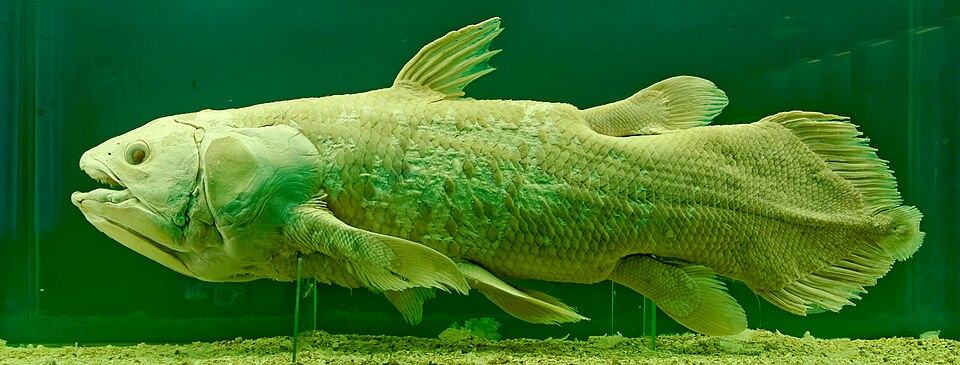
An unusual fish comes ashore
In December 1938 a catch delivered to South Africa's eastern coast contained a large bluish fish with heavy scales and fleshy fin bases. Marjorie Courtenay-Latimer, curator of the East London Museum, noticed it. London's Natural History Museum dates her encounter with the fish to 22 December, while accounts associate the catch with the mouth of the Chalumna River. This was not an expedition pursuing a legendary monster. It was a museum worker confronting a real specimen that would rapidly deteriorate. The immediate problem was practical: preserve something unfamiliar and find someone able to identify it.
A letter, a drawing and an identification
Courtenay-Latimer contacted the ichthyologist James Leonard Brierley Smith. Initially he had her correspondence and drawing; he saw the specimen itself in February 1939. Its resemblance to fossil coelacanths made the find much more consequential than an ordinary species description. The name Latimeria chalumnae commemorated the curator and the area of capture. The fishing crew also belonged to this chain of discovery: without people bringing their catch ashore, there would have been nothing for the museum to examine. Scientific recognition emerged through preservation, communication and comparison, rather than through a sighting that nobody could subsequently inspect.
Why the discovery became a sensation
Coelacanths had been thought extinct long before human history. Researchers now had a body they could measure, describe and compare with collections. Newspaper coverage readily connected this surprise with hopes for other surviving prehistoric animals. A modern coelacanth, however, was not literally an unchanged fossil individual. The familiar expression living fossil conveys the impact of finding an ancient lineage alive, but can obscure differences between living species and their distant relatives. The discovery overturned a conclusion about the disappearance of the whole group. It did not reverse geological history or provide a specimen of the plesiosaurs imagined in some lake-monster stories.
A second catch changes the geography
The next celebrated specimen came from the Comoro Islands in 1952. The Natural History Museum stresses that local fishers already knew the animal under their own name. Something unknown to international ichthyology was therefore not necessarily unknown to coastal communities. Subsequent work documented coelacanths using deep-water refuges, and Indonesian finds eventually established a second living species. The Australian Museum associates its scientific description with 1999. These later chapters matter because the story did not stop with one preserved body. Additional specimens, additional locations and observations of animals underwater allowed an initially startling identification to develop into a continuing field of research.
Evidence and the limits of the analogy
Museum specimens, anatomy and repeated discoveries agree on the central point: living coelacanths exist. The proposition that science can overlook a substantial fish is supported here by particular circumstances involving deep habitats and the history of collecting. It does not supply evidence for another proposed animal that lacks its own inspectable material. In this archive the case offers a useful comparison: an extraordinary surprise was followed by accessible specimens and revised classification. The fish belongs beside cryptid histories as a boundary case between an animal unknown to a scientific community and an established species. Its present existence is not an unresolved mystery.


