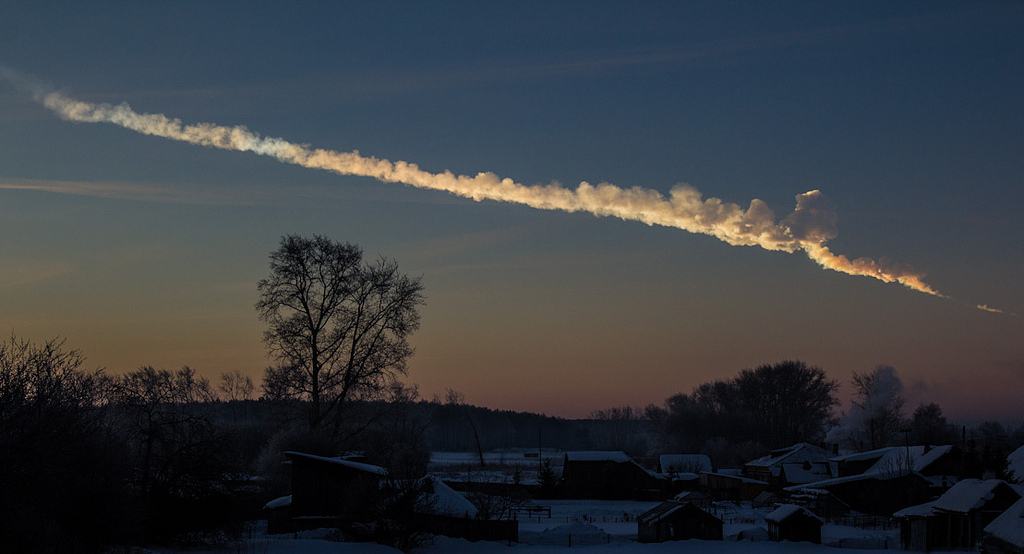
A morning that could be reconstructed
On 15 February 2013, at about 09:20 local time, a brilliant fireball crossed the southern Urals. Cameras first recorded the flash and luminous trail; the shock wave reached observers afterwards. That sequence matters: the sound delay is consistent with a distant atmospheric event rather than an explosion beside the person filming. Recordings from different locations allowed researchers to compare the direction of travel with the distribution of damage. NASA’s initial account documented a developing picture; subsequent studies combined video, instrument records and surveys of buildings.
Why size and energy estimates differ
A Nature study estimated the original object’s diameter at about 19 metres, within a 17–20-metre range, and its energy at 500 ± 100 kilotonnes of TNT equivalent. Early NASA material used 18 metres and a speed of roughly 18.6 kilometres per second. These are compatible estimates of scale derived through different methods. TNT equivalent expresses the energy of motion transferred into heating, light and mechanical effects; it does not imply a nuclear origin. The size of the incoming rock cannot simply be read from an image of its bright atmospheric cloud.
How a rock produces an airburst
At extreme entry speeds, an object encounters intense aerodynamic pressure. Fragmentation increases the surface area interacting with the air and accelerates the transfer of energy into the atmosphere. A destructive shock wave can therefore develop without a large ground crater. At Chelyabinsk, researchers compared damaged windows and buildings with calculated overpressure. Many injuries involved broken glass. The atmosphere stopped much of the incoming body, while carrying its energy over a broad area: avoiding a direct ground impact in the city did not mean avoiding consequences.
What hundreds of independent recordings contributed
A subsequently published catalogue assembled 960 videos showing different aspects of the fireball. Their value is not simply their number. Street geometry, camera positions and visible landmarks provide ways to check the trajectory. However, dashboard-camera clocks, exposure settings and image quality vary. A reliable reconstruction must reconcile the records rather than accept every displayed timestamp literally. The catalogue makes the underlying material available for further analysis and helps distinguish the visible flash from quantities inferred from it, including speed, altitude and orbit.
The trail kept travelling after the explosion
The Suomi NPP satellite detected the dust plume about three and a half hours later. According to the study described by NASA, its faster upper portion circled the Northern Hemisphere in four days; a detectable dust belt persisted for at least three months. This concerns a different timescale and a separate observing system from the dashboard cameras. Satellite measurements establish a lasting atmospheric consequence, but do not independently substitute for estimates of the original rock’s size: the movement of dust also depends on altitude and winds.
A calendar coincidence and a detection problem
The asteroid 2012 DA14 passed close to Earth on the same date. JPL’s comparison of the trajectories showed that the events were unrelated: sharing a calendar day does not establish a shared object. The Chelyabinsk impactor approached from close to the Sun’s direction, making advance detection difficult for ground-based optical surveys. The editorial lesson is an established physical mechanism alongside limited advance visibility of a small object. Its extraordinary appearance is well explained by speed and geometry; the substantive remaining questions concern detection and damage assessment.


