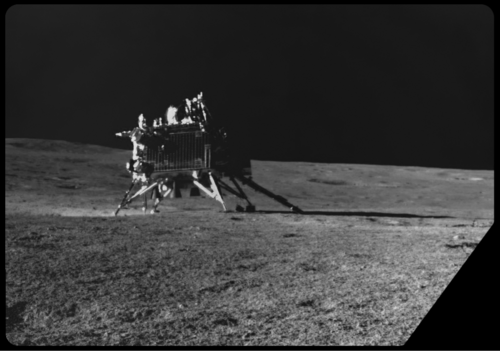
What happened on 23 August
On 23 August 2023 the Vikram lander of Chandrayaan-3 completed a soft landing on the Moon. The Indian Space Research Organisation, ISRO, developed the mission. Afterwards the Pragyan rover drove onto the surface and operated nearby. These are known spacecraft of terrestrial origin: mission records describe their journey, construction and purpose. The marker identifies their operating site, rather than a separate report of an unidentified object.
Southern latitudes are not the pole itself
Headlines sometimes shorten the description to a polar landing. A map needs more precision: the spacecraft is at approximately 69.373° south and 32.319° east. This is a southern high-latitude location, not the geographical point of the south pole. Conditions at one site cannot automatically be extended to all polar craters, permanently shadowed locations or other regions with different illumination and surface histories.
The planned area and actual touchdown
Pre-flight project descriptions define an area within which the mission was intended to find a safe site. Those coordinates belong to planning, rather than the final navigation result. For our globe we use an approximate actual Vikram position given in a subsequent NASA/JPL study. This avoids confusing the centre of the proposed zone with the spacecraft on the surface. Comparisons between maps should also account for reference systems, image resolution and positional-control methods.
What the mission measured
The lander and rover investigated different properties of their surroundings. ISRO’s archive distinguishes regolith-temperature, plasma, seismic and elemental-composition studies. Some recorded vibrations could arise from the equipment’s own activities or rover movement. An unusual pulse in a record is therefore not a ready-made identification of its cause: signals must be compared with instrument-operation times and the site’s physical conditions.
What finding sulfur means
ISRO reported that APXS detected sulfur alongside expected major elements, and that LIBS also confirmed sulfur’s presence. These instruments study chemical composition by recording characteristic elemental signatures when material is excited. Because the instruments have different fields of view and probing depths, results must be compared alongside their methods and distances from the material examined. Detecting an element does not, by itself, establish its chemical compound, a biological origin or the presence of ice. Turning that result into evidence of life or unknown technology would therefore exceed the stated measurement.
Reading the results without overreach
This record’s strength is the connection between an engineering chronology and local scientific data. But the rover examined a limited neighbourhood, not the entire Moon. Broad geological conclusions require comparisons with other sites and orbital observations. The mission demonstrates how much a known spacecraft can reveal when measurement provenance and conditions are retained. In our globe it is a documented lunar-exploration event, beside which any unusual claim must still be examined using its own original evidence.


