A dry Moon became a less simple picture
In 2008 the Indian spacecraft Chandrayaan-1 travelled to the Moon carrying an international collection of instruments. One was NASA’s Moon Mineralogy Mapper, usually called M3. Its purpose was mineral exploration: it measured reflected light across different wavelength bands rather than merely photographing familiar colours. The PDS archive preserves observations acquired from November 2008 through August 2009. Those are the measurement years used in this archive. Even after the flight ended, the observations remained available for researchers attempting to reconstruct the composition of the very uppermost lunar surface. The discovery depended on interpreting that instrument record, not on finding a visible lake in an ordinary photograph.
A signature invisible to an ordinary camera
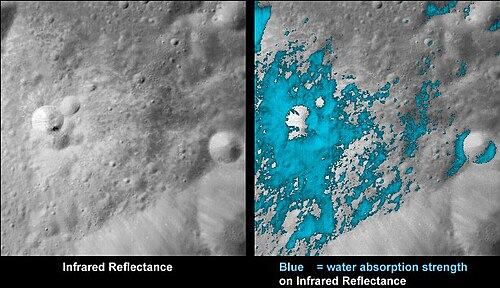
Carle Pieters and colleagues identified absorption features around 2.8–3 micrometres. On silicate surfaces, such features are associated with hydroxyl and water-bearing material. The signature was widespread and particularly conspicuous at cooler high latitudes and some fresh craters. That did not mean blue lakes had suddenly appeared on a map. A spectral feature concerns the way light interacts with molecules in surface material. It provides evidence about composition, but does not by itself reveal ice thickness, the volume of an underground reservoir or the practical economics of extracting water from the soil. Those require additional measurements and different questions.
Why other spacecraft entered the story
Comparison with other observations became an important strength of the investigation. Publications announced in September 2009 also discussed Cassini measurements and observations from Deep Impact during its extended EPOXI mission. Differences in instruments, viewing geometry and observation time matter: a fault peculiar to one instrument should not automatically account for the entire pattern. The University of Maryland described Jessica Sunshine’s initial scepticism and the subsequent analysis. Deep Impact observations added information about changes during the lunar day. An unusual spectral mark could therefore be investigated as part of a broader surface history linked to illumination and temperature rather than treated as an isolated instrumental curiosity.
Molecules rather than an imagined sea
Researchers considered a surface cycle involving hydrogen ions delivered by the solar wind interacting with oxygen-bearing minerals. Resulting material might redistribute as local conditions changed. This was a proposed physical explanation, not a direct observation of every chemical reaction happening on the ground. Early announcements emphasised relatively small quantities of water and hydroxyl. The finding should also be distinguished from the search for ice in permanently shadowed locations: the questions are related, but the measurements are different. Detecting a molecular signature does not establish that every location contains the same quantity of water at every time of the lunar day, or that a usable deposit has already been measured.
What the sources establish together
The original paper, measurement archive and team announcements agree on the central result: the surface exhibits spectral signatures of hydration. The archive establishes when observations were obtained, while team accounts describe the checks and the contribution of additional spacecraft. We therefore assign no single globe marker to a discovery covering broad surface regions. Publication time likewise does not replace the orbital observation years. Molecules interacting with lunar material are a more precise finding than the popular phrase “water discovered on the Moon”. The precision preserves what makes the episode compelling: several observational records changed a familiar picture without requiring an imaginary lunar ocean.


