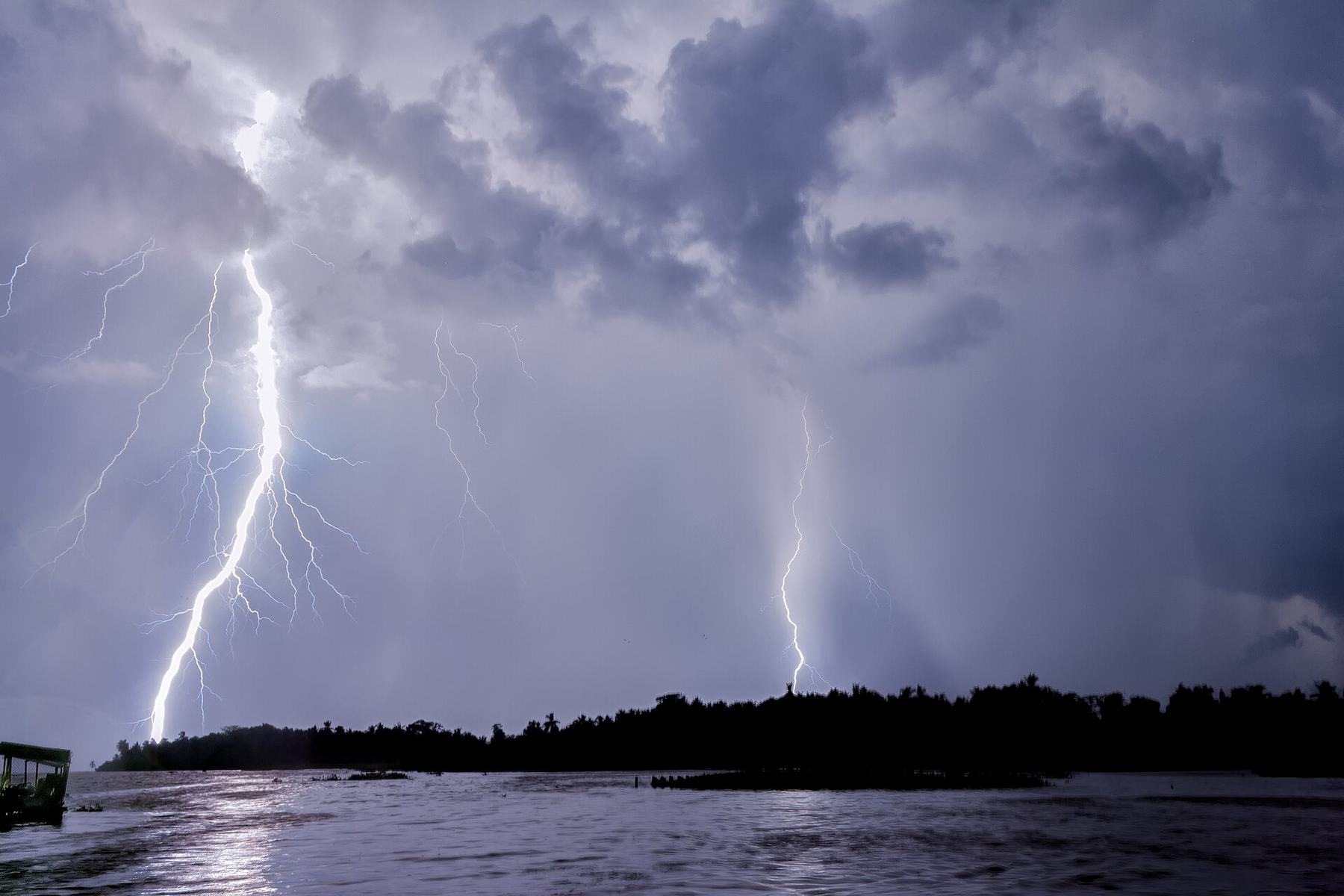
Night skies above warm water
In southwestern Lake Maracaibo, near the region where the Catatumbo River enters the lake, storms recur so frequently that they have their own name. Catatumbo lightning is also described as a natural lighthouse. It is not one bolt burning forever or a single storm existing continuously for centuries. Instead, successive thunderstorm systems form within a favorable geographical setting. To an observer, repeated activity in a similar place and at similar hours can suggest a permanent source of light. For residents and people working on the water, the same attractive rhythm represents a practical weather hazard: each discharge remains a real lightning event.
Satellites change the comparison scale
Rachel Albrecht and colleagues’ study, published in 2016, reprocessed sixteen years of Lightning Imaging Sensor observations. A finer spatial grid identified Lake Maracaibo as the principal global hotspot of flash density. Earlier analysis with a coarser grid had placed the leading maximum in the Congo basin. This did not mean that lightning suddenly moved to Venezuela in the year the paper appeared. Resolution and the method for comparing local maxima had changed. The authors associated the high density with thunderstorms repeatedly developing over a small area, rather than simply with the total size of an extensive rainy region.
Why nighttime matters
Surrounding terrain and the warm lake surface create interacting mountain, lake and sea-breeze circulations. A study by Burgesser and colleagues published in 2012 compared ground-network lightning detections with satellite observations. It identified localized activity centers, a strong nighttime cycle and seasonal maxima. These observations connect the spectacular regional phenomenon with measurable meteorology. They also demonstrate why an explanation based solely on an unusual substance in the water would be insufficient. An account must explain storm timing, geographical concentration and seasonal change, rather than merely name the region where the lightning occurs or describe its striking appearance.
From description toward prediction
Angel Munoz and colleagues’ seasonal-prediction study examined the interaction of large climate patterns and local conditions. NASA’s account of the team’s research explains the roles of atmospheric instability and nocturnal flow through the Maracaibo basin. The researchers wanted to anticipate increased or decreased activity months ahead, a different objective from warning about a particular imminent strike. Seasons of maximum and minimum activity have different predictive characteristics. Familiar regularity consequently does not mean a strict timetable: more active months, quieter intervals and variation between years remain part of the phenomenon, even when popular language calls it an everlasting storm.
What the measurements establish
Satellite mapping, ground detection and seasonal models consistently describe an intense local concentration of thunderstorm activity. Numerical estimates can differ with grid size, observation period and whether an instrument counts flashes or individual strokes. They should not be combined mechanically into one record claim. The principal pattern is associated with terrain, moisture, heat and winds; it does not require an unidentified luminous object. This entry therefore has no single observation day, because the phenomenon continues and recurs. Publication dates in the research bibliography concern results rather than the birth of Catatumbo lightning. The lighthouse metaphor conveys an impression without replacing the meteorological account of many real storms.


