More than a flash in the sky
Carancas lies in the highlands of southern Peru near the Bolivian border. A bright sky event on 15 September 2007 was followed by the discovery of a crater. Unlike stories offering only descriptions of light, this event provided an impact site and laboratory specimens. The map gives a rounded location for the fall region, rather than replacing the published field survey. The case supplies a testable material foundation for further comparisons.
Establishing the origin
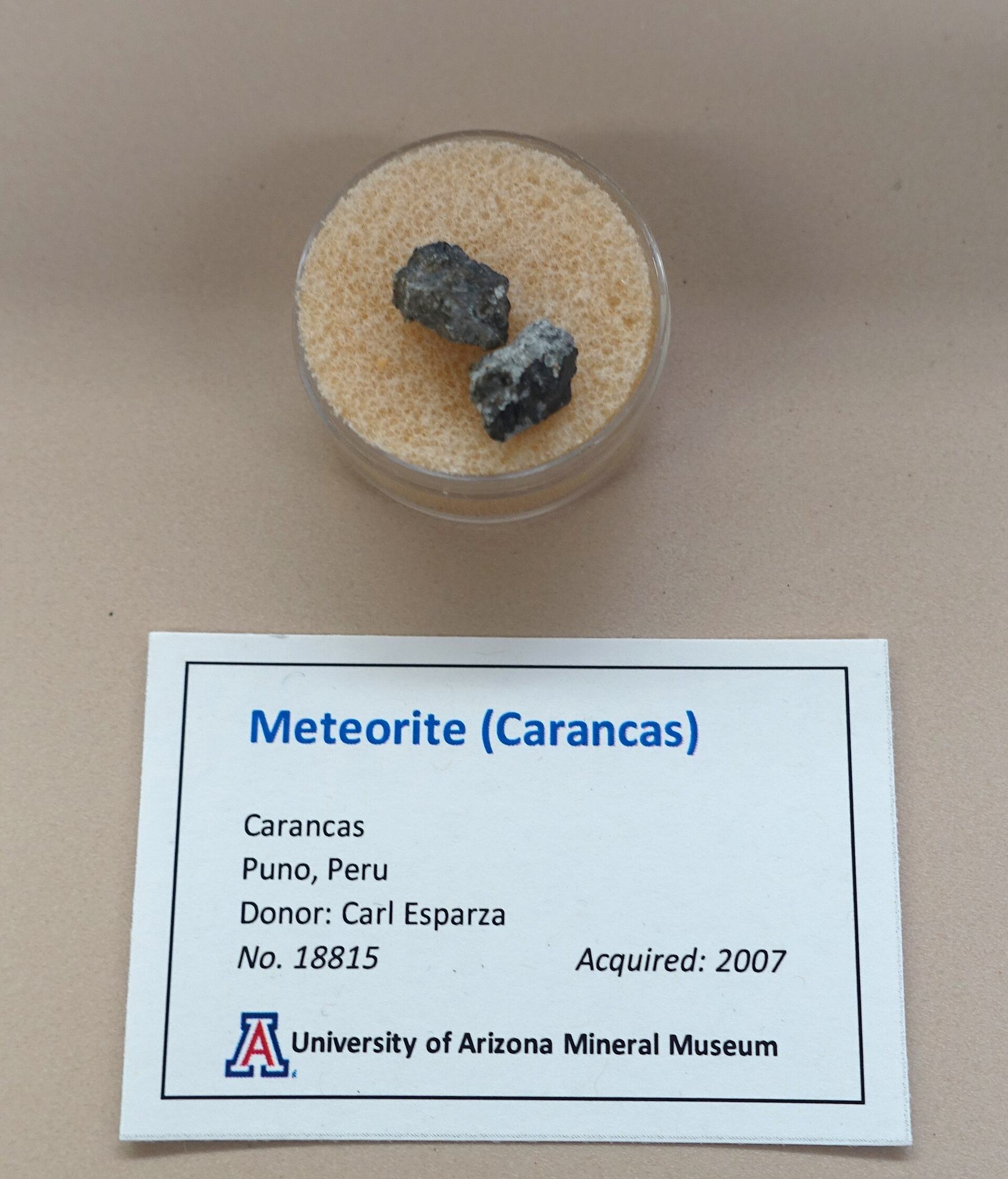
The official Meteoritical Bulletin records the fall as Carancas. The examined material is classified as an H4-5 ordinary chondrite. “Ordinary” is a meteorite classification, not a judgement about how impressive the event looked. Mineralogical evidence differs from eyewitness confidence: preserved samples can be tested again and compared with other collections.
Field investigations documented a crater roughly fourteen metres across. Sources report somewhat different dimensions; the measured boundary and surveying method should be checked before treating this as a contradiction. A paper by Peruvian researchers describes the location beside a channel and a geomagnetic survey. Such documentation makes the account testable, although each geophysical feature still needs interpretation.
Why the mechanism attracted debate
The central scientific question was not whether material arrived from space, but how a stony body retained enough directed motion to excavate this crater. Brown University's report on Peter Schultz's work addresses the unusual impact behaviour. This is a research problem involving fragmentation, aerodynamics and energy transfer, rather than a reason to replace a meteorite with an unknown vehicle.
Candidate models must explain crater dimensions, fragment properties and atmospheric behaviour together. Comparisons require assumptions about strength, initial speed and mass loss. Altering one assumption can substantially change a result. A precise number in an early interview is therefore not necessarily a final estimate, and agreement on origin does not imply agreement on every stage of flight.
Reading reports about the aftermath
Accounts of smells, fear or illness raise separate questions. Establishing their causes would require timely medical and chemical evidence, rather than temporal coincidence alone. A genuine meteorite does not automatically validate every associated claim. Conversely, uncertainty about those accounts does not invalidate analysis of the rocky material.
Carancas is strong because independent tests can be combined: a witnessed fall, a changed surface location and specimens available to specialists. Published sections, soil properties and reproducible calculations can further constrain the impact mechanism. The case demonstrates that an explained natural event can remain scientifically unusual. There are real research questions here without attributing the crater to supernatural causes or presenting a preliminary model as direct measurement of the entire process.


