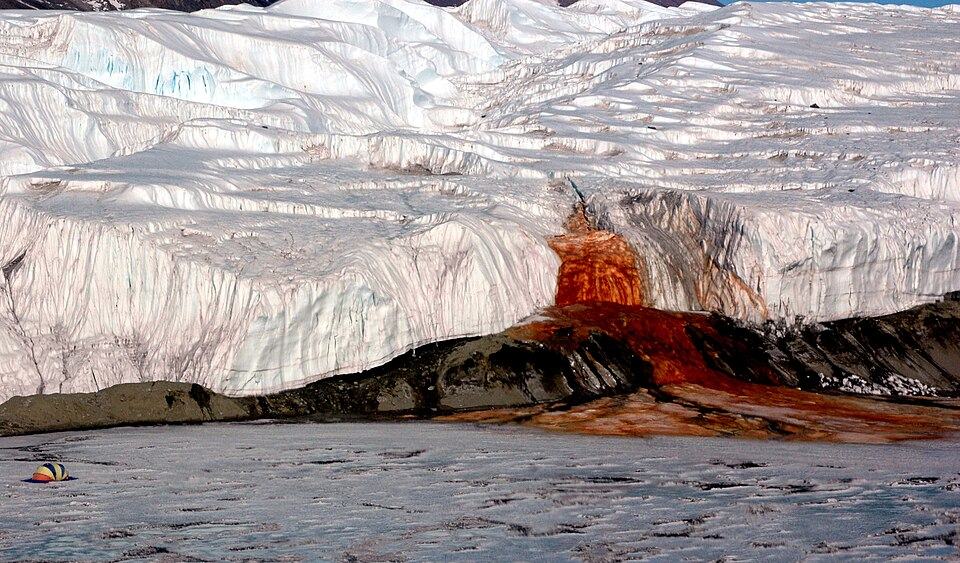
A red stain on Antarctic ice
At the edge of Taylor Glacier in the McMurdo Dry Valleys, red-orange streaks make the pale ice appear to bleed. The name Blood Falls preserves that visual impression. The University of Alaska account dates Griffith Taylor's first description to 1911, but that is not the date when the natural outlet originated. Brine emerges intermittently and stains ice beside Lake Bonney. Investigations had connected the colour with iron long before the twenty-first century. The enduring puzzle was not the literal presence of blood, but how mobile salty water could reach the surface in such a cold glacier.
A valley retaining traces of another environment
NASA's older overview illustrates attempts to connect lake chemistry with changes in the valley and an ancient marine influence. Advancing ice could isolate salty water and sediments. Such reconstructions should not become an exact calendar history without qualification. The reservoir's age and development are inferred from multiple kinds of evidence, rather than read directly from its red colour. Subsequent geochemical work sampled brine within an internal channel and compared it with surface discharges and Lake Bonney water. Explaining the salts' origins became a distinct investigation within the broader history of the falls.
Radar follows a hidden route
In research published on 24 April 2017, Jessica Badgeley, Erin Pettit and colleagues used radio-echo sounding. Transmitting and receiving antennas were moved across the glacier to compare reflected signals. Salt enhanced the contrast between brine and fresh glacier ice. Researchers thereby identified an internal region associated with delivery of water to the known outlet. This was not a photograph of a transparent underground tunnel: the structure was reconstructed through physical properties and the spatial pattern of radar reflections. Nevertheless, the observations provided a substantially more specific model than the idea that red liquid simply appeared at the ice margin by an unknown route.
Why all the water need not freeze
The study describes a combination of salinity, movement through fractures and heat released as some water freezes. Salt lowers the freezing temperature, while ice formation can concentrate the remaining solution. Released heat changes conditions around the brine pathway. Liquid inside a cold glacier is therefore not a physical contradiction. Microbiological investigations contributed another aspect: the discharge is associated with communities of microorganisms. Finding microbes, however, does not make the red streaks blood or demonstrate a hidden population of large animals. Chemical staining and biological activity form a more complex relationship than a dramatic nickname might suggest.
What is explained and what remains under study
Earlier observations, radar and chemical analyses converge on an intermittent outflow of iron-rich brine. Exposure to air produces the characteristic iron-related colour. The 2017 study improved understanding of the internal pathway, while later work refined the geochemistry. It was not the first observation of Blood Falls, nor did it simultaneously settle every question about the water's age and the valley's development. The year filter uses 1911 for the first known description; the 2017 research publication is discussed separately in the text. The striking appearance follows natural processes; scientific interest persists because a very cold glacier proved to contain an active system transporting liquid that can be investigated through successive measurements.


