A major event without a city video record
A bright atmospheric explosion occurred over the Bering Sea on 18 December 2018. Far from major cities, it did not produce the collection of dashboard videos associated with Chelyabinsk. The absence of widespread ground footage does not imply the absence of an event. This case illustrates how an investigation changes when orbital instruments provide the principal evidence instead of street-level witnesses.
What the cameras actually recorded
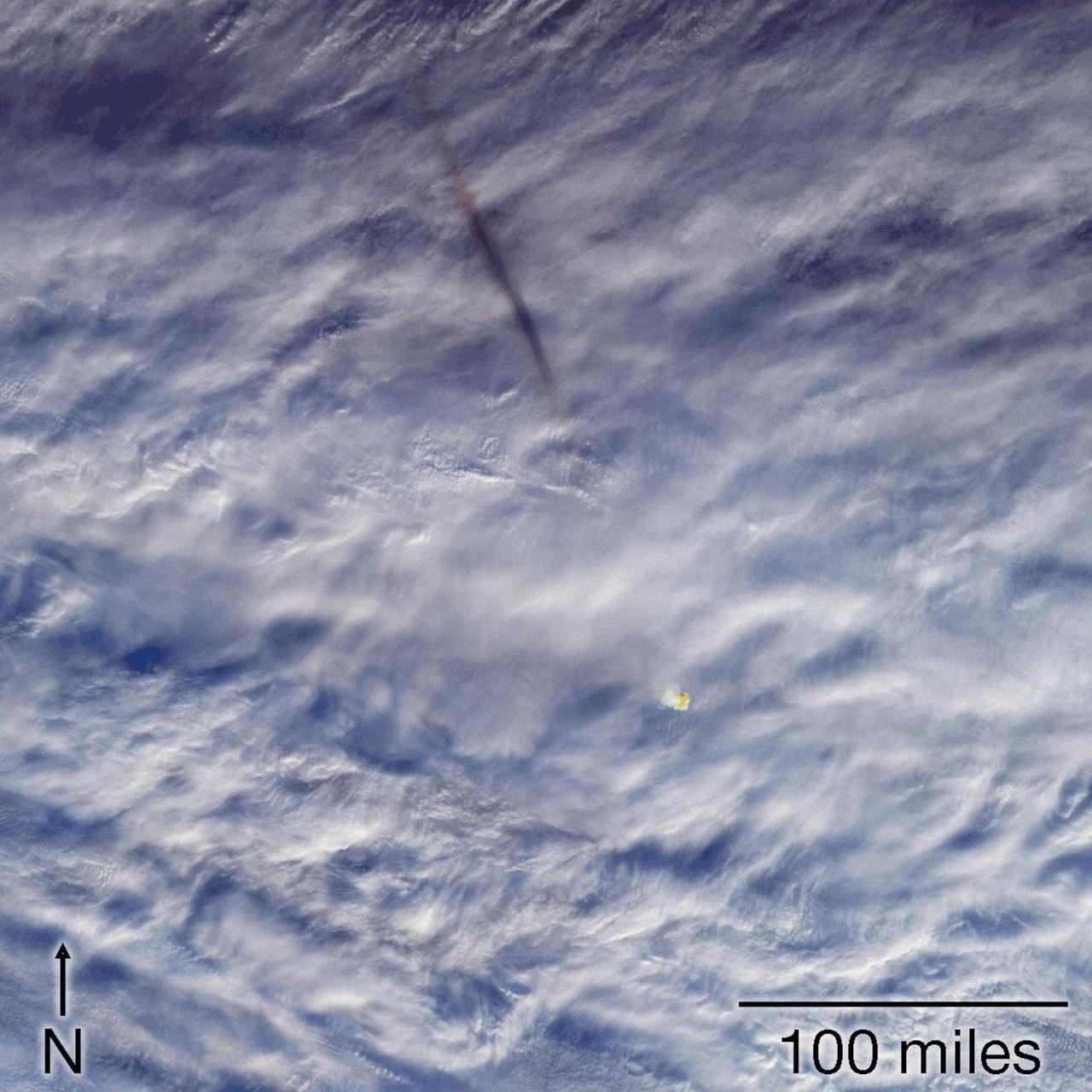
NASA published an account of the observations in March 2019. Two instruments aboard Terra imaged the aftermath. Publication date and event date must be distinguished: a picture reaching the news later does not make this a March explosion. The images show a persistent trail and its shadow, rather than continuous footage covering every stage from atmospheric entry to disruption.
MISR observes the surface and atmosphere from several angles. Its sequence reveals a coloured trail cloud and a dark projection on the clouds below. A low Sun elongated the shadow. Visually, such a long dark stripe could be mistaken for a separate moving object, but its geometric relationship to the trail can be checked against illumination direction and camera positions.
Recovering height from imagery
Stereoscopy uses the displacement of the same structure in views from different directions. Height is therefore not inferred from the cloud's colour or its resemblance to a rocket trail. Satellite position, viewing direction and the background cloud layer matter. The JPL illustration demonstrates the spatial structure. Numerical values also need checking for whether they concern the explosion location or the particular section of trail being observed.
A subsequent research paper compared Terra imagery with geostationary satellite records. Multiple platforms provide a way to test reconstruction instead of repeating one striking image. However, winds alter a dust trail. Its shape minutes later is not an unchanged ruler marking the original trajectory, so modelling must account for material movement and deformation. This is an uncertainty that can be assessed.
Why energy does not equal surface damage
NASA's initial account reported a large energy estimate. A single energy value does not describe the surface effects, however. The altitude of energy deposition, observer distance and shock-wave distribution matter. A comparison only with a familiar ground explosion can therefore misrepresent consequences in a remote oceanic region. Such comparisons need the geometry and circumstances of the event.
Atmospheric entry explains the combined observations without invoking unknown technology. Confidence in the event type remains compatible with refinement of its parameters. A particular number should be assessed through publication date, calculation method and stated uncertainty. The Bering Sea fireball illustrates why scientific certainty is not one switch: origin can be securely established while mass, fragmentation behaviour and trail details continue to be refined from the evidence.


