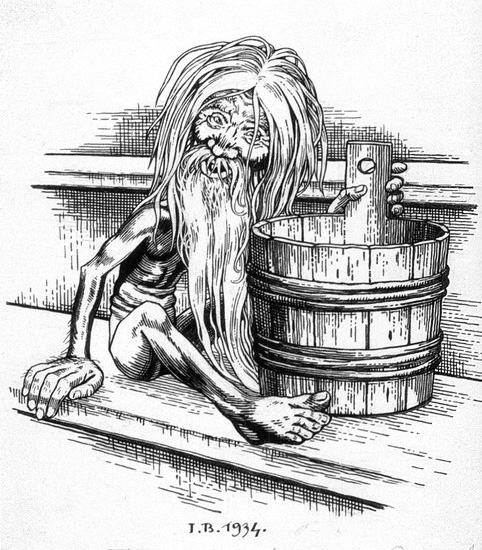
The final visitor
In Sergey Maksimov’s chapter Baennik, the village bathhouse is both necessary and dangerous. People washed after work, gave birth and prepared a bride for a change of life there. After midnight, however, the familiar building became alien territory. According to the beliefs he collected, an invisible proprietor lived beneath the bench or behind the stone stove. Human bathers had to surrender the final turn to him. Three human shifts were followed by a fourth steam reserved for the bannik and his nonhuman guests. Breaking that order transformed ordinary washing into an encounter with an angry owner.
Hot stones and retreat
Maksimov describes the threatened attack in tangible terms: the owner could throw hot stones from the stove, splash boiling water and scald the late visitor. Escape supposedly required retreating backwards towards the door. The creature need not become visible; heat, water and stone expressed its presence. The ethnographer also records offerings of salted rye bread and a more violent historical rite beneath a new bathhouse threshold. This is a description of historical relations with an imagined owner, rather than advice to reproduce them. People understood the bathhouse as somebody else’s domain, requiring permission and orderly conduct.
The husband who hurried his wife
Siberian records preserve another prohibition: never hurry somebody who is washing. The Regional Centre for Russian Language, Folklore and Ethnography publishes a narrative from Shelopugino. A husband waited for his wife, approached the bathhouse and began calling. A human skin allegedly appeared in response; the storyteller explained that the bannik-poloskun had killed the woman after the rules were broken. This horrific image cannot be presented as a verified death. It completes an instructive supernatural narrative, turning punishment for impatience into a monstrous scene. Nearby records also caution against words that urge a bather to hurry.
The proprietor changes identity
The same Siberian corpus contains masculine and feminine names, including bannyi, bannaya and bannikha. They are not necessarily members of one stable supernatural family. A museum publication about Vodlozero, based on expeditions in 2008–2009, likewise mentions bannik and bannitsa. Informants described blows from a bath whisk, a ban on visiting after midnight and the danger of excessive heat. The Russian Museum of Ethnography presents researcher Isabella Shangina discussing the owner behind the stove. Different regions preserve the bathhouse connection while varying names, appearance, the number of permitted turns and the circumstances of punishment.
Comparing records and incidents
Maksimov’s 1903 publication records beliefs already in circulation, rather than the bannik’s year of origin. Field publications record informants’ words; expedition dates concern collecting the account, not automatically the alleged encounter. Shared motifs demonstrate transmission of tradition, without independently registering one invisible being. The sources explicitly connect bathhouse danger with fumes, heat and restrictions on behaviour. A particular real injury would require its own medical and domestic evidence. Consequently no exact appearance year or map point is assigned here: these are related narratives about the boundary between human space and somebody else’s territory.


