What was reported on 3 November 1958
Nikolai Kozyrev studied Alphonsus crater using the Crimean Astrophysical Observatory’s 50-inch reflector. His account describes a changing central peak, including a reddish appearance followed by unusual brightness. The case became known through spectrograms that he associated with material being released. Our globe marks the crater’s centre as a reference for the area. That marker does not imply that the supposed source was located with the precision of modern orbital imaging.
The spectrum and the proposed interpretation
In his own publication Kozyrev interpreted the observations as volcanic activity and discussed molecular carbon. Readers should recognise this as a particular researcher’s interpretation, rather than an automatically established mechanism. A spectrum may carry more information than a coloured outline, but moving from a band on a photographic plate to the composition and origin of material requires checking the entire measurement chain.
A historical NASA survey reproduces the description of successive stages and the proposed interpretation. Its inclusion in a reference document helps locate the original account; it does not provide a second independently obtained spectrum. The date of a later article likewise does not move the observation from 1958 into its publication year.
What a catalogue entry means
Winifred Cameron’s catalogue of transient lunar phenomena compiles reports from the literature and correspondence. It is a useful guide to observations, conditions and references. Inclusion shows that an event was reported; confidence in a physical explanation must be assessed separately. Several references tracing back to one initial observation cannot be counted as separate experiments.
What would make a useful test
A renewed investigation would need the original spectrograms, wavelength calibration, exposure information, comparison regions of ordinary lunar surface and an assessment of instrument behaviour. It would need to distinguish sunlight reflected by the ground from possible additional emission and terrestrial influences on the record. The comparison should explain a specific feature, rather than merely its unfamiliar appearance.
Simultaneous data from another observatory would be especially useful, together with a sequence taken before, during and after any apparent change. A similar effect under comparable illumination would help test an observing-conditions hypothesis. Failure to reproduce it would not, by itself, identify the source.
How to read the lunar marker
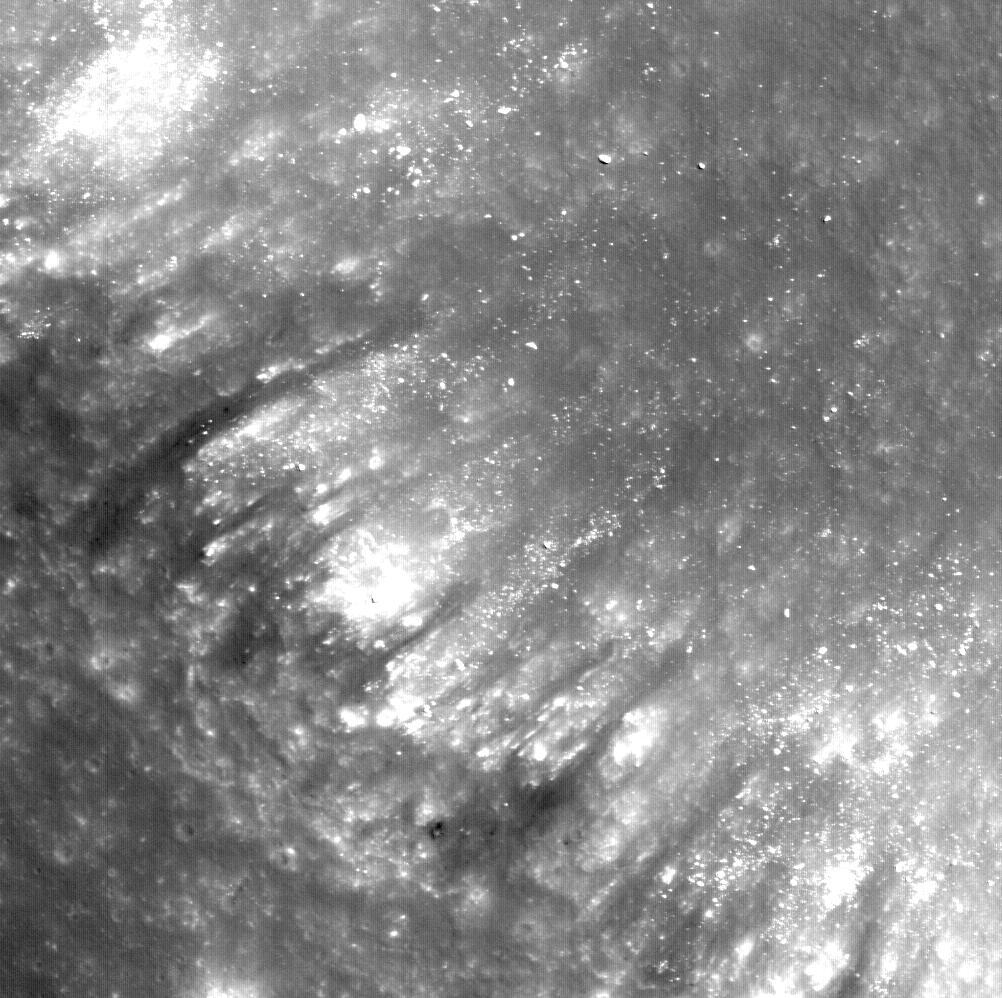
The IAU/USGS gazetteer places Alphonsus’s centre at approximately 13.39° south, 2.85° west. Those coordinates locate the crater, not an established gas release. The modern lunar texture in this interface shows terrain and is not a photograph of the 1958 event.
Kozyrev’s observations are interesting for their methods and for the history of hypotheses about present-day lunar activity. The main testable question remains specific: what did the apparatus record, and how unambiguously can it be reconstructed? A claim that extraterrestrials visited the Moon would require its own positive evidence. These historical spectrograms do not supply that evidence.


